

Joseph Williams Lovibond was an interesting chap—the son of a brewer by the name of John, whose company was based in Greenwich (that of the Mean Time—GMT—near London). At the age of 13, young Joseph became a ship’s boy and found his way to Australia, where he did a bit of gold prospecting. Distressingly for the youngster, his gold went overboard as he travelled back to the mother country, so he returned to brewing. In 1869 he set up his own brewery in Salisbury, striving always for quality. That extended to controlling the colour of his brews. While admiring stained‑glass windows in 1880, he had his Eureka moment. Starting with an old sugar bowl, he fashioned a set of coloured glass discs—red, green, and yellow—that formed the basis of what we now know as the Lovibond Comparator.
Colour, of course, is about how much light is absorbed across the visible spectrum. Down at the violet end lives the energy that excites riboflavin, which then transfers that energy to bitter substances in beer. These break down to give the unmistakable aroma of the skunk. In the UK (where there are no skunks), we simply call it lightstruck. You don’t need blazing sunshine, either—a beer can “turn” quite rapidly sitting out in the garden of an afternoon.
I was therefore well‑placed in my native England to enjoy beer inside low‑ceilinged pubs during the evening hours. A much bigger problem was that the pubs closed rather too soon for my liking—traditionally at 10:30 PM. Ten minutes beforehand the barman would shout “last orders,” urging you to choose your final drink.
Late Hopping Lagers
Back in those early days, England was most definitely ale country. Lager, by contrast, was a Continental—or Scottish—thing. Scientifically, a lager is defined by its yeast: Saccharomyces pastorianus rather than the ale yeast S. cerevisiae.
The word lagering refers to storing beer cold for maturation—‘lager’ simply means ‘to store’. Some lager beers, notably Czech Pilsners like Sierra Nevada PILS, feature late hopping, with hops added near the end of the boil so the aroma compounds survive into the finished beer.

Lupulin
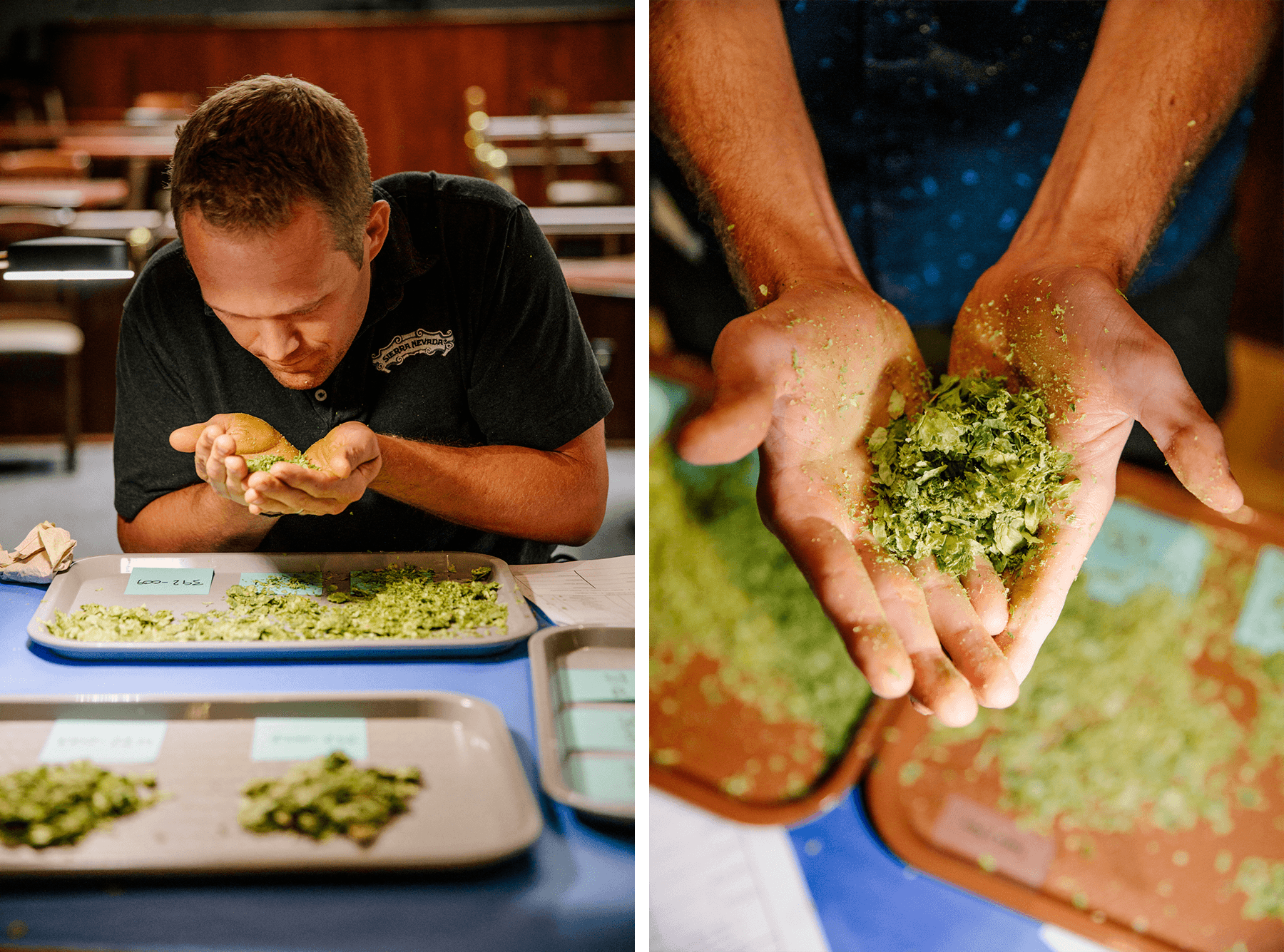
Those aroma compounds and bitter resins live in the lupulin glands of the hop cone. These bright yellow granules can be isolated and used in concentrated forms to deliver flavour and aroma with precision. Historically, hop bitterness in the UK was measured using titration with lead acetate, yielding the so‑called lead conductance value—thankfully now a relic of the past.
Lambics
One style that scarcely features hop aroma or bitterness is the lambic. These spontaneously fermented Belgian beers rely on a community of yeasts and bacteria. Their hops are traditionally aged so that the bitterness fades; fresh hop resins are antimicrobial and would inhibit the lactic acid bacteria that drive lambic’s sourness. Aged hops can take on cheesy notes, contributing to the style’s unmistakable funk.
Lambics include a considerable proportion of wheat. Wheat, barley, and other brewing grains are vulnerable to lodging—when wind or weather knocks the plants flat. This increases the risk of contamination and makes harvesting with a combine essentially impossible.
Lacing & the Lauter Tun
Grain also gives us the backbone of beer foam. A beautifully clean glass with intricate patterns of foam clinging to its sides is known as lacing. Foam stability is largely owed to a protein called LTP1—Lipid Transfer Protein 1—which naturally moves lipids around within barley. Lipids are essential in living cells but destructive to foam, so LTP1 plays an important role in forming and maintaining the beer’s head.
The clarity of wort emerging from the brewhouse matters here. The more particles still suspended in the wort, the more lipids end up travelling through the process. The separation of wort from spent grain occurs in the lauter tun.

Liquor
Many brewers refer to brewhouse water as liquor. Its composition, especially its calcium content, plays a crucial role in mash chemistry and enzyme action. One way to adjust water hardness is using limewater, which is a solution of calcium hydroxide.
Calcium influences the behaviour of starch‑breaking enzymes. One of them, limit dextrinase, is not particularly effective during a standard mash. About 20% of carbohydrates therefore remain as dextrins—unfermentable compounds that contribute to body and calories. Six of the top ten selling beers in the United States are light beers. Some brewers add an extra enzyme in the fermenter to break down dextrins, allowing yeast to ferment them and reduce caloric content.
— Charlie Bamforth


